00221081
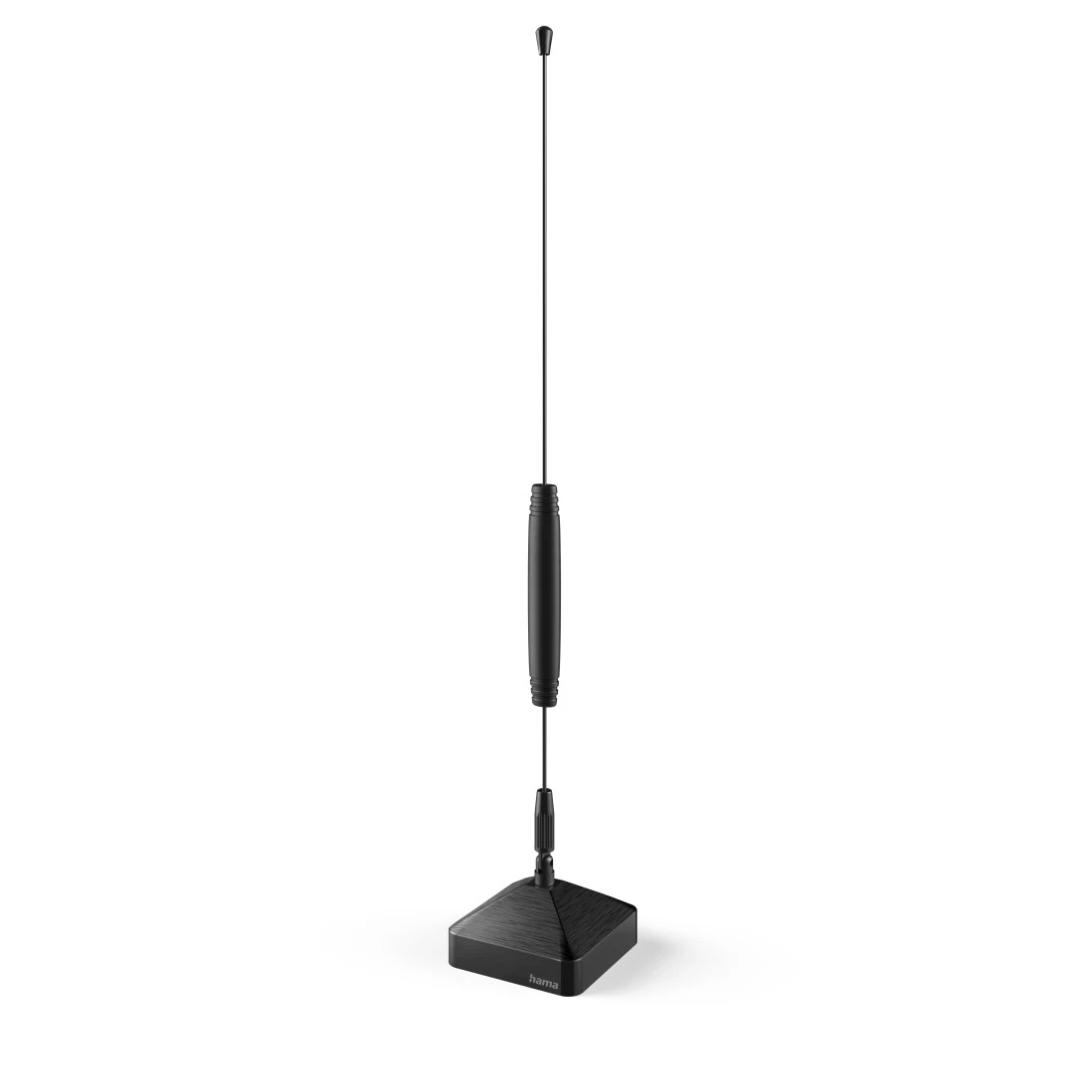
Hama "Basic" Indoor Aerial for DAB+, DAB, DVB-T2, FM, Passive, Bar
FAQs
A Smart TV can also receive TV channels with an indoor aerial if no cable connection, satellite or outdoor aerial is available. The prerequisite for this is that the Smart TV has an integrated DVB-T2 tuner.
Passive room antennas can always be used in RVs, campers, etc. With active room antennas, a power supply must be ensured – either via phantom power from the radio, TV, or USB, or via a power supply, power pack, etc.
Indoor aerials usually have the best signal reception near a window. Otherwise, it is helpful to try out different locations. Placing them at higher locations also ensures better reception.
All Hama indoor antennas are designed for FM, so analog signals can be received for an old radio. The prerequisite is that the corresponding connection, such as a coax or F-socket, is available on the radio.
No matches found
Try searching for another term, check the spelling, or adjust your filters.
Technical details
Technical Specs
| Design (Colour, Pattern, Motif, Series) | Colour | Black |
| Shade of colour | Black |
| Connectivity (Connection) | Connection | Coax Plug, F Plug |
| Power connector plug type | No Specifications |
| Electrospecific Properties | Amplification | Passive |
| Frequency Range | 87.5 -108 MHz, 174 - 230 MHz, 470 - 690 MHz, 1452 - 1479,5 MHz | |
| Technology | DVB-T/T2, Radio, TV |
| Physical Properties | Mounting | Stand Alone, Stand foot |
| Performance | 15 |
| Size & Weight | Coax Cable Length | 1.45 m |
| Height | 36 cm | |
| Length | 5.8 cm | |
| Shape | Rod antenna | |
| Width | 5.8 cm |
| Energy | Power Supply | remote power supply via antenna cable |
| Field of Application | Field of Application | Indoors |
| Usage | Indoor Antenna |
Note for Consumers
To be able to process the aerial's DVB-T2 signal, your TV must also have a DVB-T2 tuner. If it does not, you will also require a DVB-T2 receiver or DVB-T2 box. A reception forecast for DVB-T2 can be found at www.dvb-t2hd.de.